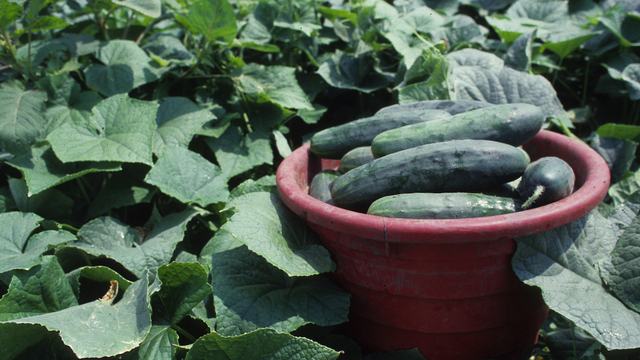
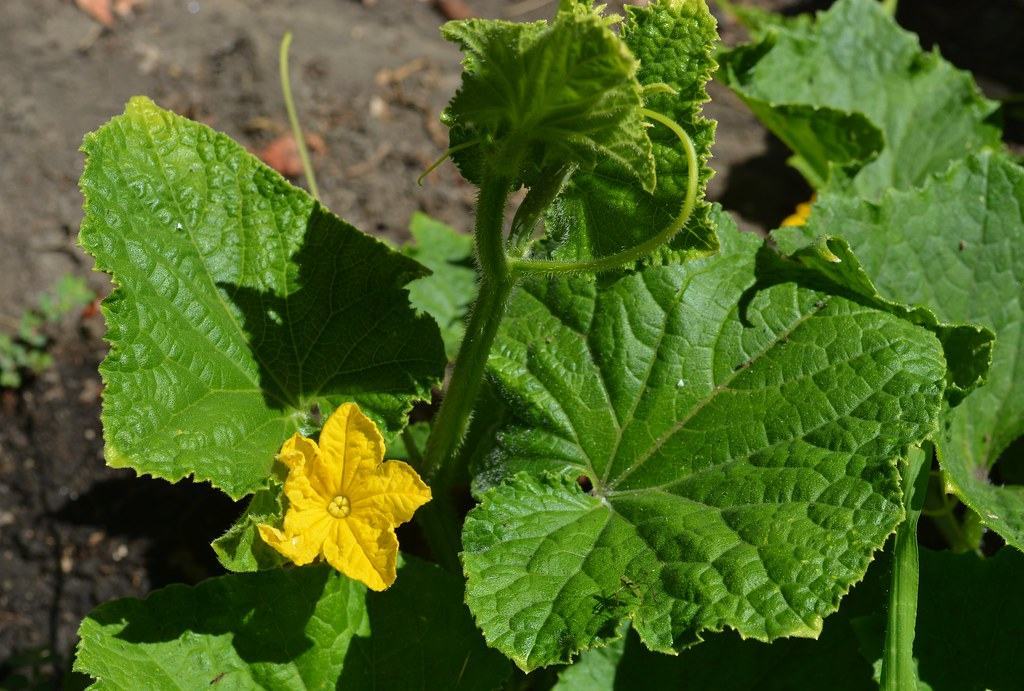
Cucumbers are among the easiest and most delicious additions to the vegetable garden. Once the heat of summer rolls around, my refrigerator is well-stocked with cold cucumbers. Great in a salad, on a sandwich, or for making homemade pickles, cucumbers are a true pleasure in a summer garden.
Growing Cucumbers in Eastern North Carolina
When to Plant Cucumbers
As a warm-season plant, cucumbers ideally are planted when soil temperatures reach 75-85 ℉. To determine the appropriate time to plant cucumbers in your area, refer to the Planting Calendars for Annual Vegetables, Fruits, and Herbs for western, central, or eastern North Carolina.
Cucumbers are sensitive to cold temperatures and can be killed with only a light frost. If you plant earlier than recommended, make sure that you have some way of protecting plants from freezing nighttime temperatures. Because of their fast growth rate and early fruit set, cucumber plants can be suitable for a fall garden as well.
Growing Cucumbers Vertically to Save Space
One of the biggest considerations for cucumbers is space. As a vine, cucumbers take up a lot of space, so ensure plants are spaced at least 8-10 inches apart.
If you grow in limited space, cucumber plants can be trained to grow along a trellis or fence to prevent them from invading other areas of your garden. An ideal trellis is a minimum of 5-6 feet tall, with a top and bottom wire and a piece of twine or plastic tied between the two wires.
This will provide a structure on which the cucumbers can grow. You want to ensure that your top wire is tight, as vines and fruits can become quite heavy when plants reach maturity.
Watering and Harvesting Cucumbers
Access to water is key! Because of shallow roots, cucumbers are susceptible to even slight drought conditions, more so than some other summer vegetables. Water soil evenly and to a depth of at least 6 inches. Watering cucumbers is even more critical during fruit set and development, so make sure your plants are not drying out during this time.
Cucumbers typically reach maturity around 50-70 days depending on the variety and should be harvested when they are about two to three inches in length. If you wait too long, cucumbers will become oversized, turn yellow, and will have a bitter flavor.
Instead of pulling directly from the vine, I cut fruits away from the plant with a sharp knife or pruning shears. Cucumbers are heavy producers, so the more you harvest, the more cucumbers you will have throughout the season.
Best Cucumber Varieties for North Carolina Gardens
There are many varieties of cucumbers from which you can choose, and choosing the right one depends on how you use them.
Best Slicing Cucumbers
If you like fresh/slicing cucumbers, ‘General Lee’ is a variety with tough flesh and excellent disease resistance and matures in about 66 days.
Another variety is ‘Sweet Slice’, a heavy producer with excellent disease resistance and a super sweet flavor. This variety is also ‘burpless’ and is a little more compact than ‘General Lee.’
‘Olympian’ matures in about 55 days and has good flavor and broad resistance to some foliar and root diseases.
Best Pickling Cucumbers
If you prefer to pickle your cucumbers, choose varieties like ‘Fancipak’, ‘Calypso’, and ‘Carolina’. The latter variety, ‘Carolina,’ is a good producer with excellent disease resistance.
There are many more varieties out there, so have fun when selecting what you want to grow. Some interesting varieties include ‘Striped Armenian’, ‘Salt and Pepper’, and ‘Lemon’ that would make tasty additions to the garden.
Bush and Dwarf Cucumbers for Small Spaces
For limited space, bush or dwarf type cucumbers that produce compact vines are also available. Recommended varieties include ‘NC-Danbury’, ‘NC-74’, ‘M 21’, ‘NC-Dixon’, and ‘Bush Whopper II’.
Common Cucumber Problems and Solutions
Preventing Misshapen Cucumbers
Misshapen fruit is a common occurrence with cucumbers and is often attributed to poor pollination or low fertility. A soil test can help in making necessary adjustments and planting pollinator-friendly plants around your garden will draw in beneficial insects.
Cucumber Diseases and Pests
Diseases are probably the most common issue for cucumbers. Choose disease-resistant varieties and mitigate excessive leaf wetness. Growing cucumbers vertically will reduce some foliar disease issues. Additional disease information can be found at this NC State Extension article on Cucurbits.
Cucumber beetles, squash vine borers, aphids, and mites can be pests of cucumbers. Early detection is critical to successfully manage pests.
If you apply pesticides, NEVER apply when plants are in flower.
Insects exposed to sub-lethal doses of insecticides can disrupt pollinator services in your garden. Additional insect pest information can be found in this NC State Extension article on Insect Management on Cucurbit Vegetables in North Carolina.
Additional Resources for Vegetable Gardening
For more information on vegetable gardening, explore the NC Extension Gardener Handbook or contact Daniel Simpson at 252-745-4121 or Daniel_simpson@ncsu.edu.