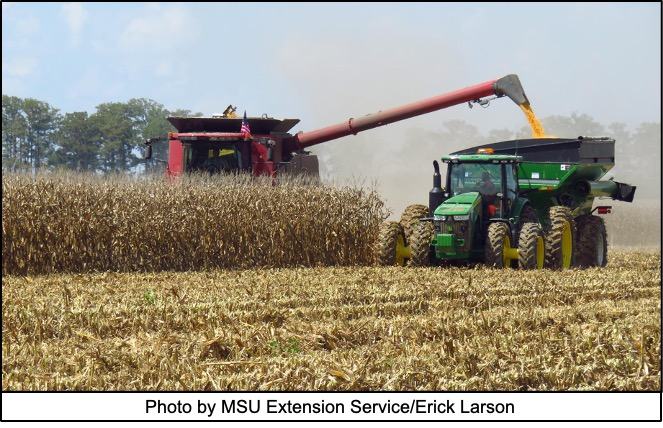
The month of August typically marks the warmest temperatures of the year, along with the start of the annual corn harvest in Pamlico County. Corn is an important NC crop used to help feed our large livestock population. While NC only ranks 19th in the United States in corn production, corn holds the second largest acreage (~17,000) in Pamlico County.
Corn is a unique crop that requires warm temperatures, consistent moisture, and adequate fertility to reach optimal yields. Corn plants go through several stages of maturity that are linked to accumulation of warm temperatures. Corn seeds require soil temperatures of about 50 degrees Fahrenheit before germination will occur. Cool weather at the start of planting season can delay emergence, which can reduce yields from the beginning of the growing season.
Corn plant growth stages can be defined as vegetative (V) and reproductive (R). Vegetative stages follow emergence (VE), with each new fully developed leaf with a visible collar referenced as a growth stage (V1, V2, etc.). Surprisingly, the corn ear that will later be harvested for grain, begins its development at a very early growth of V5-V12. At this point, the small developing corn ear is contained within the stem of the plant, and is slowly beginning to set the number of kernel rows (even number of rows around the corn ear). Modern field corn hybrids typically only produce one harvestable corn ear. While the corn plant is capable of producing numerous ears, most of the plant’s energy has been bred to favor a single ear development to maximize yield.
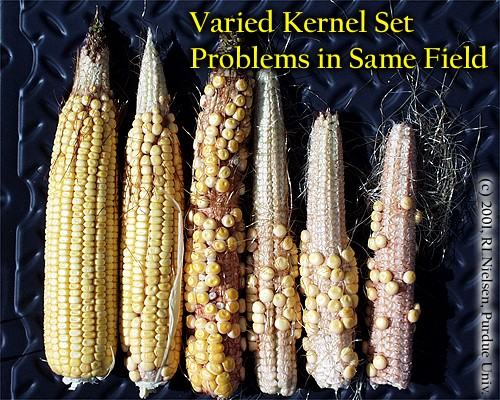
Later, as the plant matures through growth stages V12-R1, the number of kernels along the length of the corn ear are set. Stress, such as drought, heat, excessive rain, or lack of adequate nitrogen, will greatly reduce the length of the ear. This is why farmers must supply plants with sufficient levels of nitrogen fertilizer and maintain a weed free field. Without these inputs, the plant may still develop, but the corn ear will be greatly reduced in size, resulting in a low number of harvestable kernels.