Insect Note by Teresa Casey, Extension Master Gardener℠, Pamlico County Center
Description
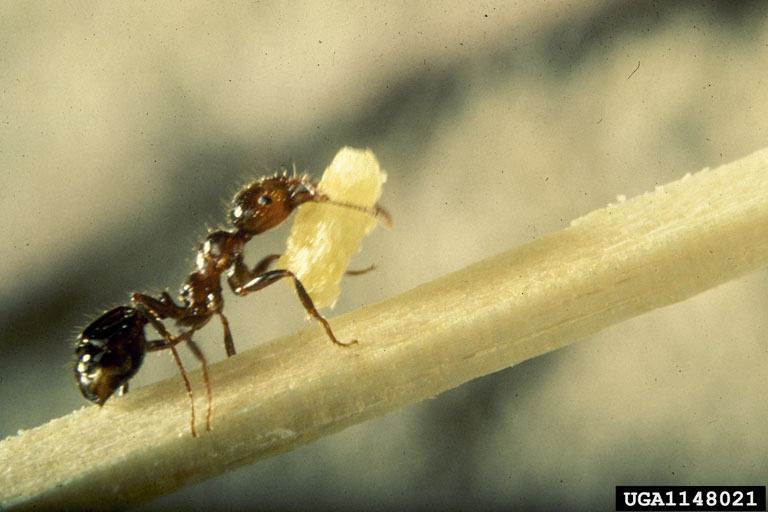
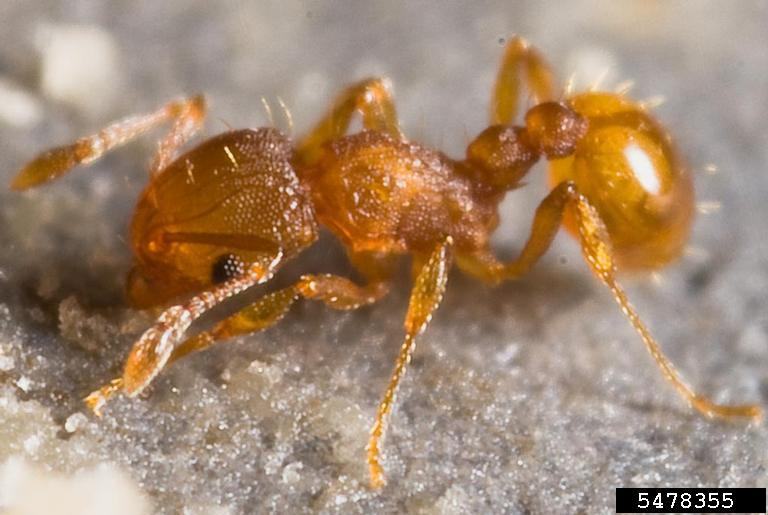
Red Imported Fire Ants (Solenopsis invicta) inhabit all or parts of many southeastern states in the US. Fire ants are small, only about 1/8 to 1/4-inch long. Variation in size is a distinguishing feature as many other ant species are uniform in size. Fire ants have a bent or elbowed antenna, a thorax followed by two nodes on the abdominal petiole and a bulbous hind part that is the abdomen. Fire ants are the only ants that have two bumps or nodes between the thorax and abdomen.
Fire ant mounds are usually a distinct dome shape with no opening at the top, which are found out in the open, not in the woods. Where imported fire ants are common, most homeowners recognize them by the mounds they build or the stings they inflict. Their aggressive nature compared to other ant species is one such trait. If a mound is disturbed, usually hundreds of fire ant workers will swarm out and run up vertical surfaces to sting.
Fire ants forage for food constantly, carrying resources back to the colony to support thousands of ants.
Damage
Fire ants in established turfgrass are considered serious nuisance pests due to mounds interfering with ball play on golf courses, damaging equipment, and are unsightly in home lawns. Additionally, when encountered by humans, pets, livestock, and other animals, their stings can cause serious pain and injury. Worker ants bite with chewing mouthparts and inject venom with their stingers aggressively and repeatedly. A day or so later, the imported fire ant’s unique venom forms a characteristic white fluid-filled pustule or blister at the sting site.
A detailed look at the fire ant’s body shows the strong jaws and stinger that make them a threat to people, pets, and wildlife.
Biology
Fire ant mounds vary in size and are a good indicator of the size of the colony. A mound that is 2 feet in diameter and 18 inches high, for example, can contain as many as 100,000 workers, several hundred winged adults and a queen.
Colony Structure and Reproduction
Fire ant colonies consist of three adult types: winged males, reproductive and worker ant females. Winged males start to fly when temperatures are between 70-95°F (spring and fall) and mate in flight. Winged males die shortly after and successfully mated females will search for a place to establish a new colony, shed their wings, and start digging chambers in the soil for their eggs.
Life Cycle
New queens lay between 12-25 eggs that hatch within 7-10 days. Established queens can lay as many as 800 eggs per day. Larvae hatch from the eggs and develop for 7-10 days before pupating. Adults emerge in about two weeks. Worker ants are wingless, sterile females that protect the colony by feeding the queen, defending the nest, foraging for food, and caring for the brood.
Control
Wait until warmer weather (between 70°F and 85°F is ideal) to treat for fire ants. During the colder seasons, the colony may have moved or burrowed well below the surface where treatments will not reach them. When treating for fire ants, sprinkle bait around the mound, not on top. Fire ants do not exit their mound from the top, but instead through side tunnels that can be several feet away. You can find additional guidance online through NC State Extension for both chemical and non-chemical control options at https://content.ces.ncsu.edu/red-imported-fire-ant-in-north-carolina#section_heading_10301.
Fire ant mounds often appear in open, sunny areas. Avoid disturbing them, as the colony inside can react aggressively.
Bait Use and Safety
It may take several weeks for baits to be taken into the nest and shared with the other ants. Baits contain an insecticide combined with food that the target insect finds palatable or attractive. In the case of ants, workers find the bait and carry it back to the colony, where it is fed to the larvae, workers, and the queen. Foraging workers may consume some of the liquid portion of the bait before returning the particle to the colony. Read the label carefully to determine the proper amount and check what protective equipment you need to wear, e.g., waterproof gloves. Also, if using chemicals, follow the label instructions! Doubling the “recipe” will not kill twice as many fire ants, but it could cause environmental harm.